

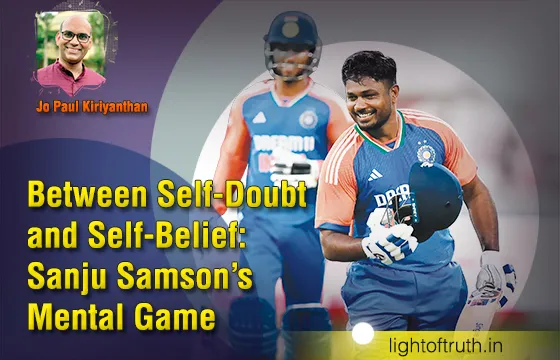
After the match against West Indies, Sanju Samson’s post-match interview stood out not only for his performance but for his honesty about self-doubt. Instead of speaking only about the innings, he spoke about the inner struggle that had accompanied his journey. Samson admitted that his career has been full of ups and downs and that he often questioned himself: “Can I make it? What if it doesn’t work?” Such thoughts, he said, are natural. The human mind often begins with negative questions, especially when expectations are high. By acknowledging this, he normalised something many people silently experience.
What is more important is how he addressed those doubts. One step he took was to reduce the noise around him. He deliberately switched off his phone and stayed away from social media for some time. In an age where athletes constantly face criticism and comparison, distancing himself from that environment helped him listen to his own thoughts rather than outside opinions.
Another important support in dealing with self-doubt is the presence of a safe circle of people. Friends, family members who listen without judging and experts who can guide with experience often become a protective environment during difficult phases. When doubts grow stronger in isolation, a trusted community can bring balance, reminding a person of their strengths and helping them see challenges more realistically.
He also used the period for honest self-reflection. Instead of becoming frustrated, he asked himself simple questions: Why didn’t it work? What can I do better? This “soul-searching” helped him focus on improving the basics of his batting, including his setup and shot selection. He reminded himself of his own abilities. He realised that the same approach had already worked for him earlier in his career. Trusting his preparation and returning to the basics helped him rebuild confidence.
Another strategy he mentioned was consciously changing his inner dialogue. When negative thoughts appeared “Can I really do it?” he tried to replace them with more positive ones. Rather than letting doubt grow, he redirected his thinking towards belief and possibility.
Alongside these practical steps, Samson has also spoken about the role of faith in his life. For many athletes, religious faith and simple spiritual practices—such as prayer, moments of silence, or reading sacred texts—become ways of grounding the mind when pressure and doubt rise. Faith often shifts the focus from constant self-evaluation to trust in a larger purpose. It helps individuals accept both success and failure with greater calm. In this way, spiritual practices can create an inner space of rest where the mind finds strength beyond immediate results.
Samson’s words show that self-doubt is not something that disappears even at the highest level of success. The key lies in how one responds to it—by stepping away from external noise, seeking supportive relationships, reflecting honestly, replacing negative thoughts, holding on to belief, and nurturing inner faith. His approach reminds us that self-doubt does not have to stop us; when handled wisely, it can become part of the journey toward growth and resilience.